
How to Calculate Electricity Bill
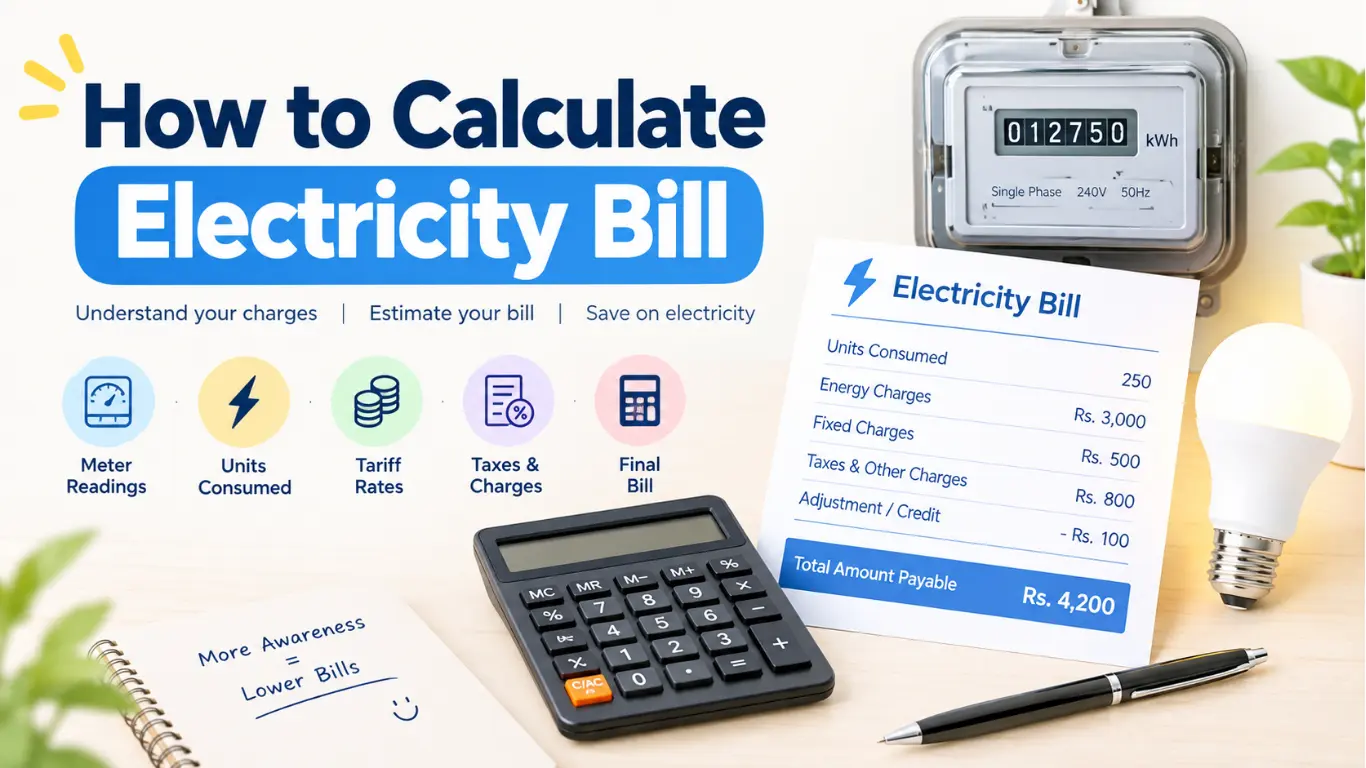
Understanding your electricity bill can sometimes feel confusing, especially when the amount is higher than expected. Your electricity bill is not based only on the number of units you use. It can also include the electricity tariff, taxes, fixed charges, meter rent, and other applicable adjustments.
If you know how these charges are calculated, you can easily estimate your monthly electricity bill and understand why the final amount changes from one month to another.
This guide explains how to calculate an electricity bill in simple steps.
What Is an Electricity Bill?
An electricity bill is the amount a consumer pays for the electricity used during a specific billing period. The main factor is the number of units (kWh) consumed.
One electricity unit means one kilowatt-hour (kWh). For example, if you use a 1,000-watt appliance for one hour, it consumes approximately one unit of electricity.
However, the final bill is usually higher than simply multiplying units by one rate because different charges and taxes may be added.
How to Calculate Electricity Bill Step by Step
You can estimate your electricity bill by following these basic steps:
- Check the previous meter reading.
- Check the current meter reading.
- Calculate the units consumed.
- Apply the applicable tariff rates.
- Add fixed charges, if applicable.
- Add government taxes and other applicable charges.
- Subtract any applicable adjustment or credit.
- Check the final payable amount.
Let’s understand each step in detail.
Step 1: Check Your Meter Readings
The first step is to find your previous and current meter readings.
Your electricity bill normally shows the previous reading and the current reading. The difference between these readings gives you the number of units consumed during the billing period.
For example:
- Previous reading: 12,500
- Current reading: 12,750
Units consumed = 12,750 − 12,500 = 250 units
So, your total electricity consumption for that billing period is 250 units.
Step 2: Understand Electricity Units
Electricity consumption is measured in kWh, commonly called units.
For example:
- 1 kWh = 1 unit
- 100 kWh = 100 units
- 300 kWh = 300 units
The number of units is important because electricity tariffs can be slab-based. This means different portions of your consumption may be charged at different rates.
For this reason, calculating the bill using one rate for all units may not give the same result as your actual bill.
Step 3: Apply the Applicable Tariff
After calculating the consumed units, you need to apply the tariff applicable to your consumer category and consumption level.
Electricity tariffs can vary depending on factors such as:
- Residential or commercial connection
- Number of units consumed
- Consumer category
- Applicable tariff slab
- Government-approved rates
- Other applicable charges
For example, if your consumption falls into different tariff slabs, the units may not all be charged at the same rate.
This is why two consumers with different consumption levels can have noticeably different bills.
Step 4: Calculate the Energy Charges
The main part of an electricity bill is usually the energy charge, which is based on the units consumed.
For a simple estimate, you can use:
Energy Charges = Units Consumed × Applicable Rate
For example, if you consume 200 units and the applicable rate for a particular calculation is Rs. 10 per unit:
200 × Rs. 10 = Rs. 2,000
This is only a basic example. Your actual electricity bill may use multiple slabs and additional charges, so the final amount can be different.
Step 5: Add Fixed Charges
Some electricity consumers may have fixed charges in addition to energy charges.
Fixed charges are not necessarily based directly on the number of units consumed. They can depend on the applicable tariff category and sanctioned load or other billing rules.
For example:
Energy Charges + Fixed Charges = Basic Electricity Charges
Always check your bill to see whether fixed charges have been included.
Step 6: Add Taxes and Government Charges
After the basic electricity charges are calculated, various taxes and government charges may be added according to the applicable rules.
Depending on the consumer and tariff category, a bill may contain charges such as:
- GST
- Electricity Duty
- TV fee, where applicable
- N.J. Surcharge
- PTV fee, where applicable
- Other government-approved charges
Not every consumer necessarily pays every charge. The exact charges depend on the applicable billing category and current regulations.
Step 7: Check FPA and Other Adjustments
Your electricity bill may also contain adjustments that can increase or decrease the payable amount.
For example, you may see terms such as:
- FPA or fuel-related adjustment
- QTA
- Previous adjustment
- Deferred amount
- Arrears
- Credit amount
These amounts can affect the final bill even when your electricity consumption has not changed significantly.
Therefore, when calculating your bill, don’t look only at the unit rate. Check the complete bill for additional adjustments.
Simple Electricity Bill Calculation Formula
A basic electricity bill calculation can be understood with this formula:
Total Bill = Energy Charges + Fixed Charges + Taxes + Other Applicable Charges − Adjustments/Credits
For example, suppose:
- Units consumed = 250
- Estimated energy charges = Rs. 3,000
- Fixed charges = Rs. 500
- Taxes and other charges = Rs. 800
- Adjustment/credit = Rs. 100
Then:
Total Bill = 3,000 + 500 + 800 − 100
Total Bill = Rs. 4,200
This is a simplified example for understanding the calculation. Your actual bill depends on the tariff and charges applicable to your connection.
Why Does the Electricity Bill Increase?
Many consumers are surprised when their bill increases even though they believe their electricity usage has remained similar.
There can be several reasons for this increase:
Higher Unit Consumption
Using air conditioners, heaters, water pumps, refrigerators, and other high-power appliances for longer periods can significantly increase electricity consumption.
Tariff Changes
Electricity rates can change under government-approved tariff decisions. A change in rates can increase your bill even if your unit consumption remains similar.
Additional Taxes
Taxes and other charges can also affect the final payable amount.
Fuel and Other Adjustments
Adjustments added to electricity bills can increase or decrease the total amount.
Arrears
If an earlier amount remains unpaid, it may appear as arrears on the current bill and increase the amount payable.
How to Calculate Electricity Consumption of an Appliance
You can also estimate how many units an appliance uses.
Use this formula:
Units Consumed = Appliance Wattage × Hours Used ÷ 1000
For example, suppose you have a 1,000-watt appliance and use it for 5 hours:
1,000 × 5 ÷ 1,000 = 5 units
So, the appliance consumes approximately 5 units during those five hours.
For a 100-watt appliance used for 10 hours:
100 × 10 ÷ 1,000 = 1 unit
This simple calculation can help you understand which appliances are consuming more electricity.
How to Calculate Monthly Electricity Cost
To estimate your monthly electricity cost, first calculate the expected consumption of your appliances.
For example, if your household consumes approximately 300 units per month, you can use the current applicable tariff structure to estimate the energy charges. Then add fixed charges, taxes, and other applicable charges.
However, the exact bill should always be checked against the official bill because tariff slabs and additional charges can change.
Check Your Electricity Bill Online
If you want to understand your bill more accurately, checking the latest electricity bill online can be useful. Most electricity distribution companies provide online bill-checking facilities where consumers can view their current bill using information such as a reference number or consumer ID.
Your online bill usually provides important details, including:
- Billing month
- Previous meter reading
- Current meter reading
- Units consumed
- Tariff details
- Current charges
- Taxes
- Adjustments
- Due date
- Total amount payable
Checking these details can help you identify why your bill is higher or lower than the previous month.
Final Words
Calculating an electricity bill is not as difficult as it may seem. Start by checking your previous and current meter readings and calculate the units consumed. Then consider the applicable tariff slabs, fixed charges, taxes, and other adjustments.
Remember that a simple units × rate calculation gives only an estimate. The actual payable amount can include several additional charges and adjustments.
By regularly checking your electricity consumption and understanding the different sections of your bill, you can better manage your monthly electricity expenses and identify unusual changes in your bill.